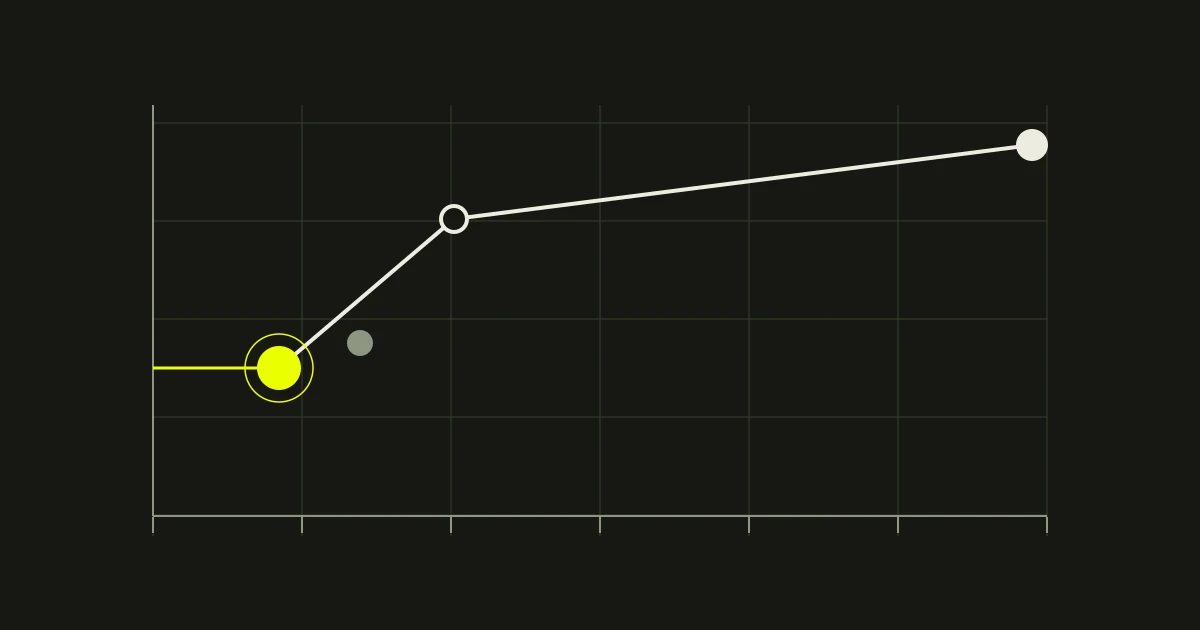
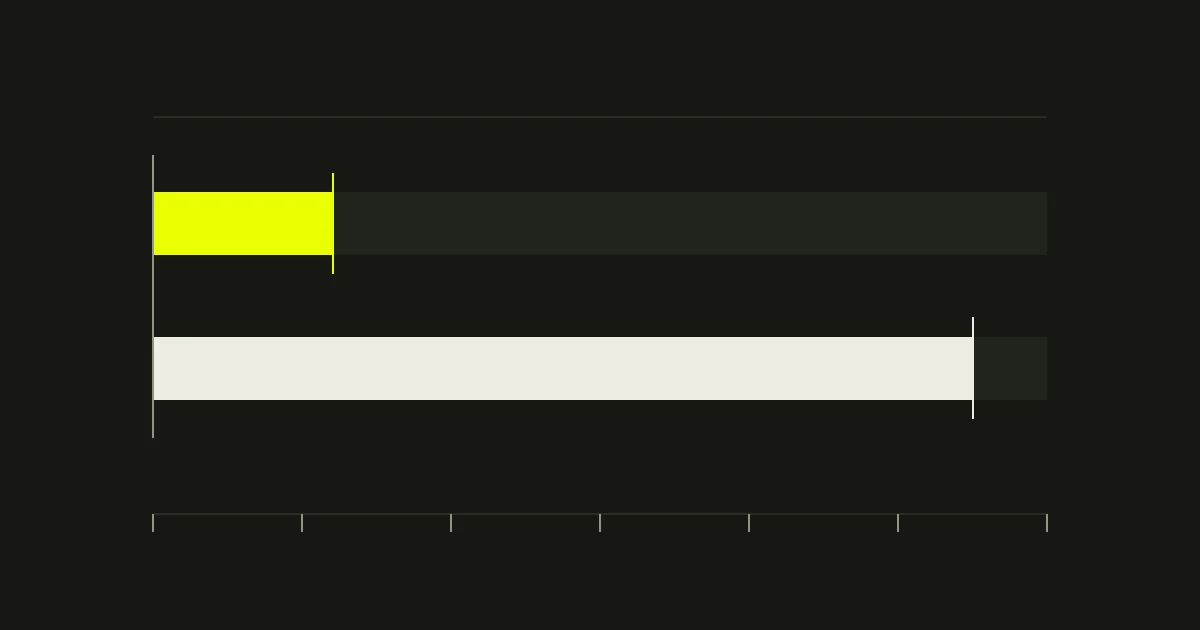
Grok 4.7 charges less for output. GPT-6.1 Sol costs less on the index.
Grok 4.7 output is $6 per million tokens against Sol's $10. At High, the index bill runs the other way. Where X Search changes the decision.

GTM Architect & Growth Operator · Now · 10 November 2026 · 4 min read
On this page
Grok 4.7 lists output at $6 per million tokens. GPT-6.1 Sol lists it at $10. In Artificial Analysis’s comparison, a High-effort Grok attempt costs $6.18 per index task. Sol High costs $0.59 and scores 15 points higher.
I would start with Sol for general automation. I would give Grok a separate trial if access to new posts and threads on X was part of the job.
Automation and terminal results
| Model and effort | Score | USD / task | Automation | Terminal |
|---|---|---|---|---|
| GPT-6.1 Sol Xhigh | 52 | $0.76 | 66.6% | 54.0% |
| GPT-6.1 Sol High | 50 | $0.59 | 64.5% | 51.5% |
| Grok 4.7 Xhigh | 35 | $7.77 | 65.6% | 25.8% |
| Grok 4.7 High | 35 | $6.18 | 63.5% | 24.7% |
| GPT-6.1 Sol Low | 35 | $0.16 | 52.6% | 30.8% |
Artificial Analysis Intelligence Index v5.0.1, checked November 10, 2026. Costs are weighted estimates per attempted task. Grok at High is one percentage point behind Sol High on AutomationBench-AA, a test of business workflows. On Terminal-Bench, the gap is 26.8 percentage points. Grok High and Sol Low share a rounded aggregate score of 35 with very different profiles. That tie says little about an individual workflow.
Cache reads can change the invoice
| API spec | Grok 4.7 | GPT-6.1 Sol |
|---|---|---|
| Uncached input / 1M | $2 | $2 |
| Cached input / 1M | $0.50 | $0.10 |
| Output / 1M | $6 | $10 |
| API context window | 500K | 1.05M |
| Long prompt rates: input / cached input / output | Above 200K: $4 / $1 / $12 | Above 272K: $4 / $0.20 / $15 |
Grok API pricing · Sol API pricing. The higher rates apply to the whole request after the threshold.
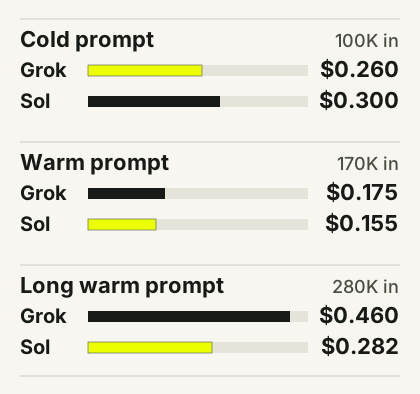
| Hypothetical request | Grok 4.7 | GPT-6.1 Sol |
|---|---|---|
| 100K fresh input, 10K billable output | $0.260 | $0.300 |
| 150K cached + 20K fresh input, 10K billable output | $0.175 | $0.155 |
| 260K cached + 20K fresh input, 10K billable output | $0.460 | $0.282 |
These examples hold token counts fixed and exclude cache writes and tools. In the short tier, the extra $0.40 per million cache reads can eat the $4 per million saved on output: it breaks even at ten cached input tokens for each billable output token. A long-running agent that reloads the same brief on every turn can cross that line quickly. Log actual cache hits and reasoning tokens before drawing a conclusion from the example.
When I would try Grok
Start with one task where recent information on X would change a decision. For example: find five newly reported incidents affecting a vendor we depend on. Return the original post, the date, the scope of the issue and an official status link where one exists. Count duplicate rumours as one signal. Mark anything unconfirmed.
Run it twice. First give both models the same frozen evidence and judge the brief. Then let Grok use X Search and give Sol the best retrieval setup you already operate. That second test measures the whole workflow. X Search lists $5 per 1,000 posts fetched and $10 per 1,000 profiles fetched, on top of tokens. Record those charges and how many additional verified signals the tool found.
This is an API comparison. Grok Bot can run routines and choose a model on your behalf. Its documentation says it can route to third-party models and does not reveal the model used on a request. To evaluate that product, measure the brief it delivers, the data it can access and the work someone still has to do.
The product comparison applies those checks to a recurring CRM brief. Grok Bot vs ChatGPT Work
Questions people ask
Is Grok 4.7 cheaper than GPT-6.1 Sol?
It has cheaper standard output tokens and more expensive cache reads. In Artificial Analysis’s High-effort runs, Sol costs $0.59 per index task and Grok costs $6.18.
Is Grok Bot the same as Grok 4.7?
No. Grok 4.7 is an API model. Grok Bot is an agent product that chooses a model for each task.